
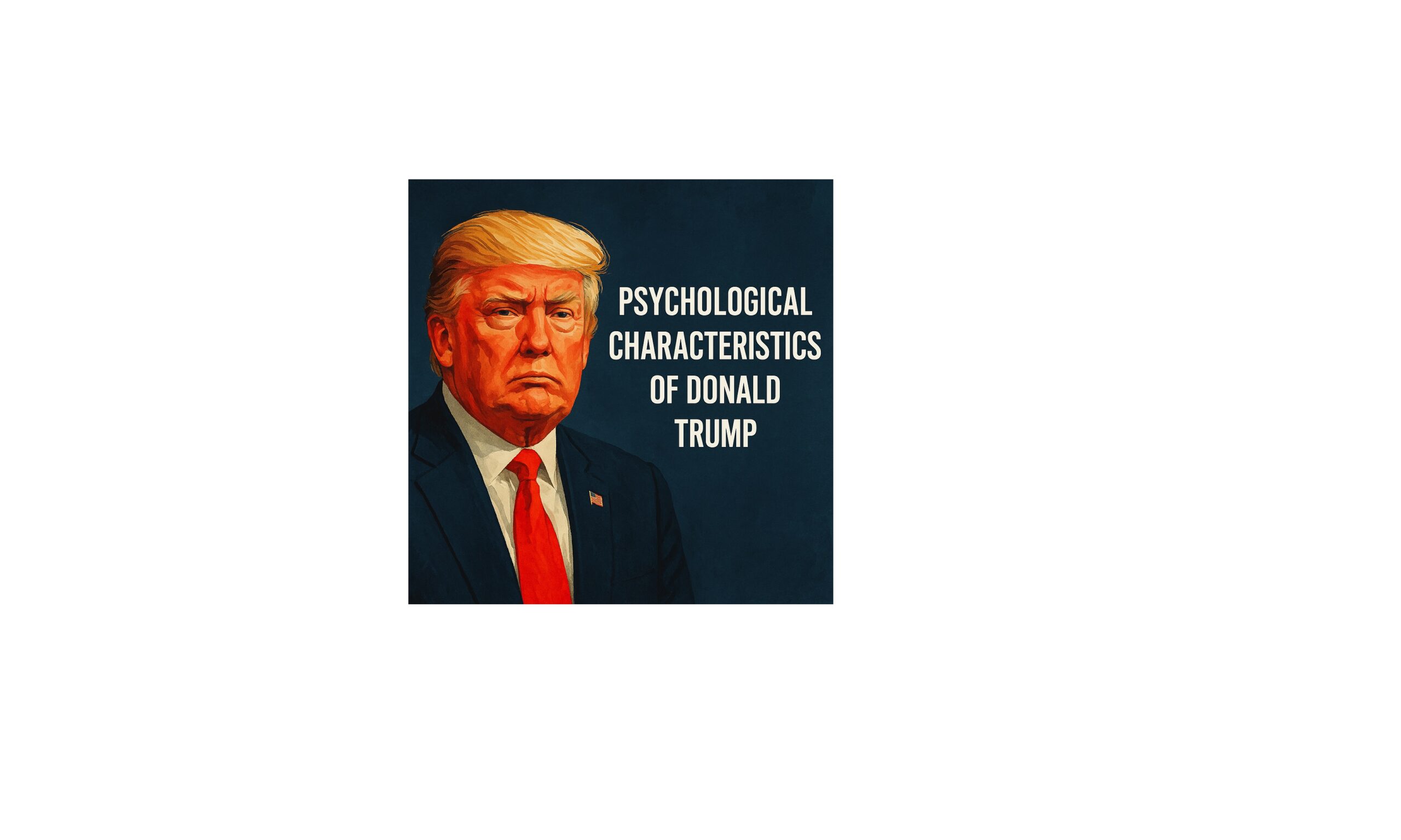
PSYCHOLOGICAL AND GEOPOLITICAL ANALYSIS OF DONALD TRUMP’S PRESIDENCY (2025–2029): RISKS FOR DEMOCRACY, GLOBAL ORDER, AND UKRAINE
Viktor BED
Doctor of Theology, Doctor of Law, Professor,
Research Institute for Strategic and Political-Legal Studies
of the Carpathian University named after Augustin Voloshyn
Uzhhorod, Ukraine
October 17, 2025
Abstract
This study offers an interdisciplinary examination of Donald Trump’s personal-behavioral, psychological, and cognitive traits during his second term as President of the United States (2025–2029). Drawing on credible open sources, it investigates how the intersection of narcissism, emotional instability, cognitive simplicity, and populist leadership style influences democratic resilience, transatlantic unity, global security, and the sustainability of support for Ukraine in the context of the Russian-Ukrainian war. The analysis outlines key scenarios of political development, identifies strategic risks for the U.S., the EU, and the democratic world, and highlights the crucial role of psychological and value-based determinants in shaping modern political leadership.
Keywords: Donald Trump, psychological analysis, populism, narcissism, cognitive structure, democratic resilience, Ukraine, United States, European Union, NATO.
Introduction
The second term of Donald Trump, which began on January 20, 2025, and will last until January 20, 2029, holds profound historical and political significance for assessing the resilience of democratic institutions in a world characterized by hybrid wars, disinformation campaigns, technological rivalry, and increasingly personalized forms of political leadership [1].
The modern political landscape demands a deeper understanding not only of institutional mechanisms but also of the psychological, cognitive, and moral-value dimensions that determine the behavior of state leaders and directly influence the stability of the international security system. Within this context, Donald Trump’s personality serves as an illustrative example of the complex interconnection between individual psychology, political ambition, and global dynamics, all of which shape international decision-making, security strategies, and public trust in democratic institutions.
The assessments and characteristics presented in this paper are of a scholarly-analytical, behavioral-psychological, and cognitive-political nature, grounded in observable patterns of behavior, public statements, and credible open-source information [2]. The study seeks to identify
the main risks, challenges, and potential scenarios of global political development during Donald Trump’s presidency, while evaluating their implications for democracy, transatlantic unity, and the security of Ukraine, the European Union, and the broader democratic world.
Psychological and Behavioral Portrait
Narcissistic and Demonstrative Traits
Donald Trump’s public speeches, communication style, behavior in the media, and constant pursuit of self-glorification reveal a pronounced pattern of narcissistic behavior, characteristic of personalities with a heightened need for recognition and dominance [4].
He exhibits a distinct model of public self-presentation in which external effect, improvisation, and emotional hyper-reactivity outweigh logical consistency or strategic argumentation.
Trump systematically:
- exaggerates his achievements, presenting them as unprecedented global successes;
- reacts sharply and aggressively to any criticism, perceiving it as a personal threat;
- constructs a clear dichotomy of “me versus enemies,” where political opponents or critics are automatically turned into personal adversaries;
- prefers theatrical expressions, hyperboles, and sarcastic remarks instead of rational argumentation.
Such behavioral tendencies form a hypercompensatory personality structure, in which the outward display of strength, confidence, and superiority often conceals inner insecurity, fear of losing control, or a constant need for external validation [5].
This type of psychological self-regulation is typical of leaders with a strong power drive, where the public image substitutes deep self-reflection, and emotional impulse replaces rational planning.
In the political dimension, such demonstrative behavior contributes to the emergence of a charismatic yet conflict-prone leadership style, one that appeals to the emotions of the masses while often disregarding institutional limits and the norms of political culture.
Emotional Instability and Impulsiveness
A characteristic feature of Donald Trump’s behavior is high emotional reactivity and a tendency toward sudden emotional outbursts, which frequently result in inconsistency of statements and decisions, as well as aggressive or sarcastic reactions in public communication [6].
His activity in the media and on social networks is marked by excessive expressiveness, rapid changes in tone — from enthusiastic to confrontational — and acute sensitivity to criticism or loss of control over the narrative.
Such manifestations of emotional instability are accompanied by heightened excitability and a low level of self-regulation, making his decisions often impulsive, situational, and reactive. Abrupt changes of position, public insults directed at political opponents, journalists, allies, and even his own advisers, create the image of a politician living in a state of constant affective tension, where emotional reaction dominates over strategic thought.
This trait produces a specific pattern of political behavior in which immediate emotion outweighs long-term strategy, and the image of a “decisive and unpredictable leader” serves as an instrument of control and projection of strength. At the same time, such a model makes the politician vulnerable to external manipulation, as adversaries can provoke uncalculated actions through psychological triggers — such as flattery, challenge, humiliation, or feigned respect.
Cognitive Superficiality and Deficit of Analytical Thinking
Despite possessing formal education in business and finance, Donald Trump demonstrates low cognitive complexity — a limited capacity for multilayered analysis, synthesis of information, and the construction of causal relationships [7]. His political and communicative behavior indicates a predominance of intuitive-emotional thinking over analytical reasoning, expressed in a tendency toward simplified conclusions, overgeneralizations, and categorical judgments.
Trump’s statements are often devoid of logical consistency, and his arguments rely on emotional associations and subjective notions of success, rather than on verified facts or expert assessments. His cognitive style gravitates toward binary oppositions — “friend or foe,” “victory or defeat,” “loyalty or betrayal” — which significantly reduces the flexibility of political thinking and the ability to reach compromise.
A notable feature is the absence of reflective continuity — the capacity to comprehend the causality of one’s own actions, their long-term implications, or systemic context. Consequently, his strategic decisions often take on a fragmentary and reactive character, dominated by situational benefits and image effects. This gives rise to political conduct that is guided not by rational governance but by emotional self-assertion through public confrontation, media attention, or symbolic victories.
The deficit of analytical reasoning is further evidenced by Trump’s dependence on an echo-chamber environment, which reinforces his preconceptions without correction from professional experts or strategic advisers. Such a cognitive pattern — driven more by intuition than analysis — leads to decision-making errors, particularly in complex geopolitical contexts that demand multidimensional assessment of facts, risks, and consequences.
From a scientific standpoint, Trump’s cognitive superficiality constitutes a factor of strategic unpredictability, complicating forecasts of his political behavior and making it highly dependent on emotional and media stimuli. This presents serious challenges for diplomatic partners, particularly Ukraine, the European Union, and NATO, as decisions may shift not due to strategic logic but in response to psychological or image-related motivations [8].
Political-Psychological Vulnerability and External Manipulation
The complex of traits described above — narcissism, emotional reactivity, impulsiveness, and cognitive superficiality — creates in Donald Trump a heightened political-psychological vulnerability to external influence. His behavioral structure combines a deep need for approval and dominance with a persistent craving for affirmation of his personal importance, making him highly susceptible to flattery, personal attention, and the illusion of “special relationships” with powerful figures.
These weaknesses are skillfully exploited by authoritarian leaders, foremost among them Vladimir Putin — a terrorist, war criminal, and President of the aggressor state, the Russian Federation (RF). The Kremlin’s strategy toward Trump is built not on open confrontation but on psychological manipulation, combining flattery, ostensible “respect,” and an exaggerated simulation of equality between leaders. Such tactics aim to foster a sense of personal trust, which gradually transforms into dependency and informal loyalty [9].
Through these mechanisms of influence, Moscow achieves several strategic goals:
- Weakening transatlantic unity by undermining the trust of the United States toward its European allies;
- Provoking internal American conflicts by amplifying social divisions and political polarization;
- Promoting pro-Russian information narratives aimed at discrediting Ukraine, NATO, and the European Union;
- Encouraging isolationist and anti-Ukrainian decisions within U.S. leadership, aligning with the Kremlin’s geopolitical interests [10].
Thus, Trump’s personal and behavioral deficiencies become a factor of geopolitical risk: a psychologically driven egocentrism that generates potential for manipulation by authoritarian regimes seeking to weaken democracy and erode the international system of collective security.
In this sense, the figure of Donald Trump emerges not only as a domestic phenomenon within American politics but also as a component of the broader global struggle between democracy and autocracy, in which psychological influence and information manipulation have become key instruments of hybrid warfare.
Risks for Democracy, Governance, and the International Order
Donald Trump’s personal characteristics — narcissism, emotional instability, cognitive superficiality, and impulsive decision-making — pose significant risks to the functioning of the democratic system of the United States and to the stability of the global political order. Their impact manifests on several interrelated levels: domestic, institutional, and international.
Internal Risks to Democracy
The key consequence of this type of leadership is the erosion of democratic institutions. Trump’s inclination to personalize power and subject institutions to his own political will leads to the weakening of the checks and balances system that underpins the U.S. constitutional model.
Under the pressure of presidential influence, courts, law enforcement agencies, intelligence structures, and independent media may become politicized. This process cultivates a culture of personal loyalty instead of institutional accountability, gradually undermining citizens’ trust in the state.
Simultaneously, social polarization deepens, and public discourse degenerates into a binary confrontation of “us versus them.” Such dynamics exacerbate internal division and create the preconditions for political radicalization among segments of the population.
Governance Risks
Trump’s impulsiveness and desire for unilateral control render the system of governance unstable and unpredictable. Instead of collective decision-making based on expert assessment, policymaking becomes voluntaristic, where the priority is not the substance of policy but its image value.
As a result, bureaucratic efficiency declines, professional motivation among civil servants weakens, and state policy acquires a reactive rather than strategic character. These tendencies undermine institutional coherence and generate risks for the rule of law within the domestic political system.
International Consequences
In foreign policy, Trump exhibits isolationist tendencies, often dismissing multilateral frameworks and alliances. His personal negotiation style reduces international relations to transactional logic — a “deal-for-benefit” approach — that erodes the perception of the United States as a guarantor of stability and international law.
The disruption of transatlantic partnerships leads to a weakening of NATO and diminishes the unity of the Western world — vulnerabilities that authoritarian powers such as Russia, China, Iran, and North Korea actively exploit.
This destabilization of the international system creates a window of opportunity for revisionist regimes, which seek to alter borders by force and legitimize aggression as a tool of state policy.
Risks for Ukraine and the Democratic World
For Ukraine, Trump’s presidency poses potential threats in the form of political pressure to accept a “peace on the aggressor’s terms,” which contradicts the principles of international law, territorial integrity, and just peace.
An additional challenge lies in the risk of “agreements without Ukraine’s participation,” which could lead to a revision of international legal norms, undermine the principles of state sovereignty, and trigger new inter-state territorial conflicts.
Even rhetorical or diplomatic signals of such intent undermine the global security system, foster distrust among allies, and embolden authoritarian regimes to pursue further acts of aggression.
Global Challenges
At the global level, Donald Trump’s political behavior contributes to the systemic destabilization of the democratic world. When the world’s leading democracy displays internal weakness, it legitimizes authoritarian practices, provides moral justification for dictators, and diminishes the United States’ authority as a defender of democratic values.
In this environment, democratic states are compelled to redefine their strategic responsibility, developing new mechanisms of self-protection — from institutional autonomy to regional defense coalitions and “alliances of truth and law.”
Potential Scenarios of Development
Managed Turbulence
In this scenario, the state institutions of the United States — including Congress, the judiciary, the Department of Defense, and key analytical agencies — continue to perform their checks-and-balances function, keeping the president’s impulsiveness within acceptable limits. The formal mechanisms of democracy — the independence of the courts, the free press, public oversight, and political competition — still ensure the systemic resilience of governance.
Despite partial reputational losses on the international stage (caused by inconsistent statements, abrupt diplomatic gestures, or situational compromises), the U.S. institutional structure remains functional and viable. Domestic political polarization grows, yet it does not escalate into uncontrolled destabilization.
For Ukraine and its allies in the EU and NATO, such a scenario would mean the preservation of existing frameworks of cooperation, though with lower predictability and occasional delays in decision-making. Overall, this represents a state of unstable equilibrium, where the system retains a capacity for self-correction but requires continuous balancing — internally through institutional maturity, and externally through allied engagement and pressure.
Gradual Institutional Erosion
This scenario envisions the progressive weakening of democratic mechanisms of restraint and oversight that underpin the stability of the American political system. The president, leveraging his popularity among part of the electorate and his influence over the media space, begins to expand personal control over key state structures, replacing institutional logic with a logic of loyalty.
The result is a shift of decision-making centers toward the executive branch, where competence is increasingly replaced by devotion. Outwardly, democratic procedures remain in place, yet the actual roles of Congress, the courts, and independent regulators gradually diminish. This condition is often accompanied by information pressure on opposition media, efforts to discredit critics, and the rewriting of political rules under the guise of “system renewal.”
In foreign policy, such a trajectory implies inconsistency and volatility of the U.S. position and a growing dependence of international decisions on the president’s emotions and personal interests. The unpredictability of Washington’s actions generates opportunities for manipulation by authoritarian regimes, especially Russia and China, which exploit every indication of internal weakness in the West.
For Ukraine, the consequences of this scenario are particularly risky: the likelihood of political bargaining over issues of war, security, and assistance increases; U.S. support becomes situational; and the international coalition against aggression becomes fragmented.
Institutional erosion in the United States would directly reflect on the weakening of the global system of collective security, opening the way for further aggression by totalitarian states.
Systemic Crisis and Destabilization
This scenario marks a transition from managed turbulence to a deep internal political crisis, where key state institutions lose their ability to operate independently of the executive branch. Such a state emerges when the president openly challenges the legitimacy of judicial rulings, electoral processes, and the authority of Congress, while the executive hierarchy effectively transforms into a personally controlled structure.
At this stage, democratic mechanisms become performative, and the balance of powers collapses. The president’s attempts to extend his personal will over the military, intelligence, media, and judiciary create the premises for an authoritarian model of governance, disguised under formal institutional shells.
Simultaneously, societal polarization intensifies: one part of the citizenry supports authoritarian tendencies as a form of “renewal through strength,” while the other enters active opposition, raising the risk of violent protests or localized clashes.
At the international level, this scenario entails a crisis of confidence in the United States as the leading democratic power. Allies in NATO and the EU face increasing uncertainty in U.S. decision-making, while authoritarian regimes — notably Russia, China, Iran, and North Korea — obtain a “window of opportunity” for geopolitical revanche.
Russia, in particular, may attempt to impose a “peace without Ukraine” or advance initiatives legitimizing the occupation of Ukrainian territories, exploiting the weakening of international solidarity.
For Ukraine, such a systemic crisis in the United States would represent an existential challenge. A sharp reduction of U.S. military aid, a decrease in sanctions pressure on Russia, and paralysis of the UN Security Council would create the conditions for a new wave of aggression and a dramatic shift in the balance of power in Eastern Europe.
Overall, the scenario of systemic destabilization in the United States carries global repercussions: the erosion of trust in democratic governance, the strengthening of autocratic powers, and the acceleration of a hybrid Third World War — waged simultaneously in political, economic, informational, and moral-value dimensions.
Recommendations
For Ukraine
- Expand defense-industrial partnerships with the European Union, the United Kingdom, Canada, and Japan to reduce dependency on politically sensitive U.S. decisions.
- Establish permanent diplomatic monitoring in Washington, D.C., and in the U.S. Congress to ensure continuous engagement and advocacy of Ukrainian interests.
- Strengthen strategic communication and information diplomacy, emphasizing Ukraine’s role in global security and demonstrating to U.S. policymakers that assistance to Ukraine is not charity, but a matter of shared democratic interest and deterrence [14].
- Develop domestic military-technological autonomy, ensuring self-sufficiency in key defense sectors and sustainability of national defense production.
For the European Union and NATO
- Create insurance-based defense funds with fixed long-term procurement programs, independent of national electoral or political cycles.
- Accelerate the development of the European defense-industrial complex, enhancing the continent’s capacity for coordinated production of armaments and critical components.
- Harmonize sanctions policy and energy diversification strategies to prevent economic and political fragmentation within the Alliance.
- Maintain a united and public position in response to any anti-NATO statements or isolationist tendencies in U.S. policy.
For the United States and the Democratic World
- Reinforce the institutional independence of Congress, the judiciary, and the media to safeguard democratic accountability from political manipulation.
- Guarantee automatic and bipartisan continuity of defense and security assistance programs for allies, particularly Ukraine.
- Strengthen nonpartisan channels of interaction between governmental, civic, and academic institutions to ensure strategic policy continuity regardless of political cycles.
- Form a “coalition of truth and law” — a concerted platform of democratic states that affirm the inadmissibility of border revisionism, aggression, and the erosion of international law [15].
Generalization
- The political phenomenon of Donald Trump exemplifies how individual psychological traits can become a factor of global politics. The combination of charisma, narcissistic demonstrativeness, emotional instability, and cognitive superficiality has created a distinct model of leadership in which the power of image replaces the substance of state strategy.
- Trump embodies a crisis of rational politics in the age of mass communication, where emotional manipulation and media resonance take precedence over the depth and coherence of decision-making. His political behavior demonstrates that even mature democracies are vulnerable to the personalization of power and institutional erosion, especially when public consciousness yields to the allure of the “strong leader” myth.
- At the same time, Donald Trump represents one of the clearest examples of populist leadership, in which personal charisma, emotional rhetoric, and appeals to the “real people” replace rational argument and programmatic consistency. His communication strategy relies on the exploitation of fear, resentment, and the image of a “betrayed majority,” mobilizing the electorate through simple, emotionally charged messages. This approach reduces political reality to a “people versus elite” conflict, creating an illusion of direct democracy that in practice undermines institutional stability and the culture of responsible governance.
- On the domestic level, this model leads to the erosion of democratic foundations, the radicalization of certain social groups, and a decline in public trust in the system of checks and balances. On the international level, it results in decreased predictability of U.S. actions, the weakening of alliances, and the encouragement of authoritarian regimes to adopt more aggressive strategies.
- For Ukraine, these tendencies carry direct strategic implications. The sustainability of U.S. support, the consistency of sanctions policy, and the unity of the international coalition against Russian aggression depend on the institutional resilience and rational leadership of the United States. Any populist oscillation in Washington’s policy increases the risk of a “peace on the aggressor’s terms” or “agreements without Ukraine,” threatening international law and the principle of territorial integrity.
- Consequently, the psychological structure of political leadership and its populist style of communication have become crucial factors in global security. Understanding these dynamics enables scholars and policymakers alike to forecast not only the behavior of individual leaders but also the broader transformations of political culture in the 21st century — from collective responsibility to emotional manipulation of the masses.
- The experience of Donald Trump’s presidency confirms that the strength of democratic nations lies not in the charisma of their leaders but in the resilience of their institutions, the moral responsibility of their elites, and the maturity of their civil societies. These foundations remain the most reliable guarantors of freedom, justice, and the rule of law in the modern world.
References
- S. Constitution. Twentieth Amendment — Presidential Term and Succession. Library of Congress, Constitution Annotated. Retrieved October 17, 2025, from https://constitution.congress.gov/constitution/amendment-20/
- American Psychiatric Association. (n.d.). The Goldwater Rule. Retrieved October 17, 2025, from https://psychiatry.org
- Lee, B. (Ed.). (2017). The Dangerous Case of Donald Trump: 27 Psychiatrists and Mental Health Experts Assess a President. Macmillan. Retrieved October 17, 2025, from https://us.macmillan.com/books/9781250256287/thedangerouscaseofdonaldtrump/
- McAdams, D. P. (2016, June). The Mind of Donald Trump. The Atlantic. Retrieved October 17, 2025, from https://www.theatlantic.com/magazine/archive/2016/06/the-mind-of-donald-trump/480771/
- Lewis, T. (2021). The “Shared Psychosis” of Donald Trump and His Loyalists. Scientific American. Retrieved October 17, 2025, from https://www.scientificamerican.com/article/the-shared-psychosis-of-donald-trump-and-his-loyalists/
- Dolan, E. W. (2025, January 20). The Psychological Puzzle of Donald Trump: Eye-Opening Findings from 20 Studies. PsyPost. Retrieved October 17, 2025, from https://www.psypost.org/the-psychological-puzzle-of-donald-trump-eye-opening-findings-from-20-studies/
- McAdams, D. P. (2021). The Episodic Man: How a Psychological Biography of Donald J. Trump Casts New Light on Empirical Research Into Narrative Identity. Europe’s Journal of Psychology, PMCID: PMC8763223. Retrieved October 17, 2025, from https://pmc.ncbi.nlm.nih.gov/articles/PMC8763223/
- , T. G. (2019, December 2). Diagnosing Public Figures Is Risky … And Very Controversial. Psychology Today. Retrieved October 17, 2025, from https://www.psychologytoday.com/us/blog/do-the-right-thing/201912/diagnosing-public-figures-is-risky-and-very-controversial
- How Has the Relationship Between Trump & Putin Evolved? (2025, July 9). The Guardian. Retrieved October 17, 2025, from https://www.theguardian.com/us-news/2025/jul/09/has-the-trump-putin-bromance-finally-run-its-course
- Bing, C., Paul, K., & Satter, R. (2024, September 9). Russia Is Focusing on American Social Media Stars to Covertly Influence Voters. Reuters. Retrieved October 17, 2025, from https://www.reuters.com/world/russia-focusing-american-social-media-stars-covertly-influence-voters-2024-09-09/
- Trump’s Attacks on Elections and the Rule of Law. (2020, November 24). The Washington Post. Retrieved October 17, 2025, from https://www.washingtonpost.com/politics/trump-election-democracy/2020/11/24/e78b8194-2e6a-11eb-bae0-50bb17126614_story.html
- Understanding Democratic Decline in the United States. (n.d.). Brookings Institution. Retrieved October 17, 2025, from https://www.brookings.edu/articles/understanding-democratic-decline-in-the-united-states/
- The Transactional World Donald Trump Seeks Would Harm, Not Help, America. (2025, February 27). The Economist. Retrieved October 17, 2025, from https://www.economist.com/briefing/2025/02/27/the-transactional-world-donald-trump-seeks-would-harm-not-help-america
- Hvizda, M., Frederick, B., Laufer, A., Evans, A. T., Gunness, K., & Ochmanek, D. A. (2025). The Implications of the Fighting in Ukraine for Future U.S.-Involved Conflicts. RAND Corporation (Report RR-A3141-2). Retrieved October 17, 2025, from https://www.rand.org/pubs/research_reports/RRA3141-2.html
- Collective Defence and Article 5. (n.d.). NATO. Retrieved October 17, 2025, from https://www.nato.int/cps/en/natohq/topics_110496.htm
- Rumer, E. (2024, November 25). The United States and the “Axis” of Its Enemies: Myths vs. Reality. Carnegie Endowment for International Peace. Retrieved October 17, 2025, from https://carnegieendowment.org/research/2024/11/the-united-states-and-the-axis-of-its-enemies-myths-vs-reality?lang=en
