
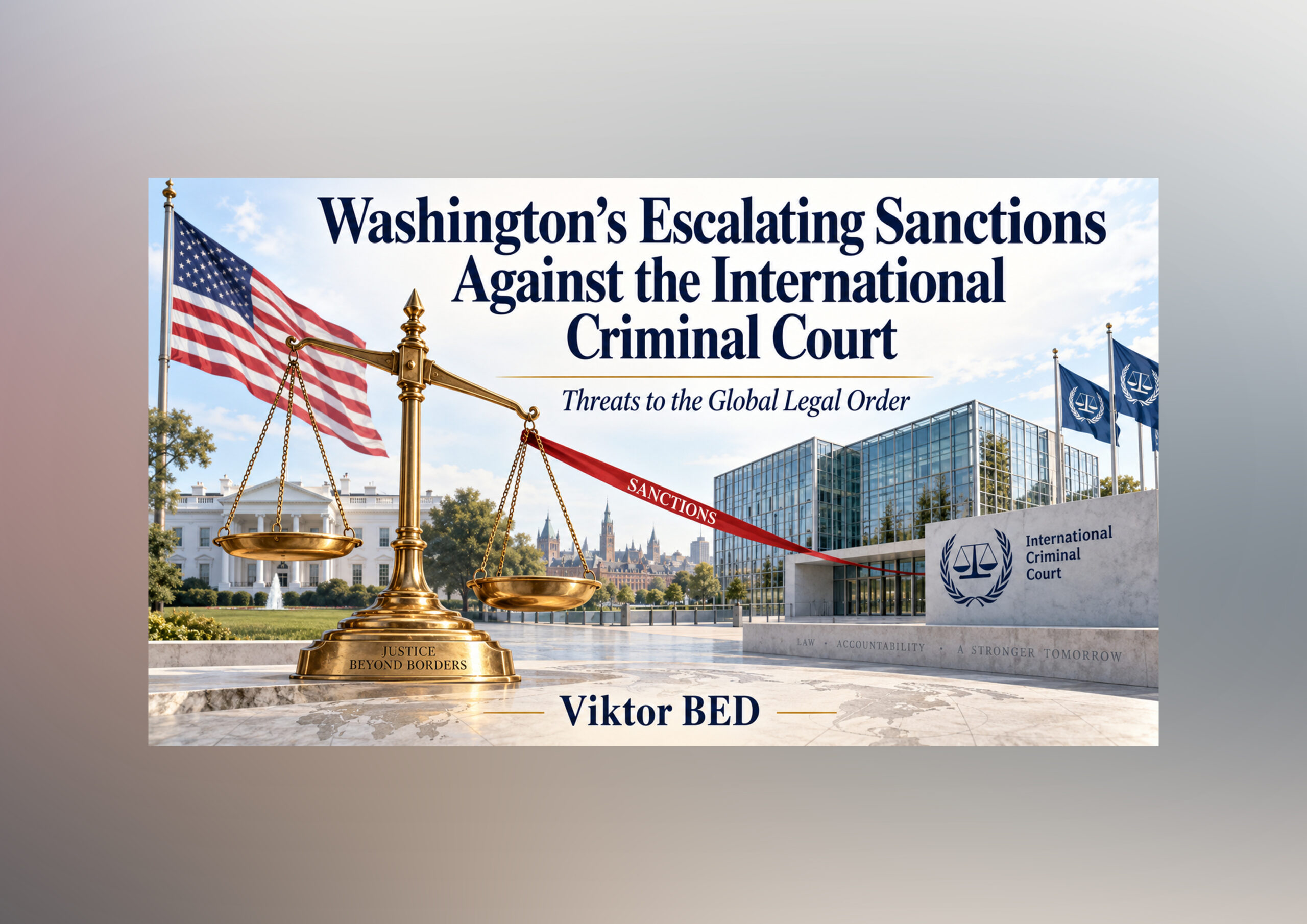
Washington’s Escalating Sanctions Against the International Criminal Court: A Political and Legal Analysis and Threats to the Global Legal Order
Viktor BED
Doctor of Theology, Doctor of Law, Professor
Research Institute for Strategic, Political and Legal Studies
Augustyn Voloshyn Carpathian University
Uzhhorod, 22 September 2026
Introduction and Relevance of the Issue
Reports by international media outlets—Reuters and The Wall Street Journal—that the US administration is preparing comprehensive sanctions against the International Criminal Court (ICC) as an institution and a subject of public international law indicate that the confrontation between American sovereigntism and international justice has entered a phase of systematic dismantling of treaty-based mechanisms [1; 2]. Whereas Washington previously confined itself to targeting individual judges and prosecutors, its intention to obstruct the Court’s operations as a whole represents an attempt to undermine the ability of a permanent institution of international justice to fulfil its mandate.
The timing of this initiative is revealing. The 81st session of the United Nations General Assembly officially opened on 8 September 2026 under the presidency of Khalilur Rahman, with the stated theme “Restoring trust, managing transformation: a United Nations that delivers for all.” The annual high-level General Debate opened on 22 September 2026, providing the customary forum for addresses by world leaders, including US President Donald Trump [3; 4]. The preparation of sanctions and the disclosure of information about them on the eve of these debates are intended to publicly undermine the principle of multilateral cooperation and send an ultimatum to the 125 States Parties to the Rome Statute, whose representatives are gathering at UN Headquarters in New York.
The Leader’s Psychological and Political Profile: Accentuated Personality Traits, Destructive Behavioural Patterns and Donald Trump’s Inner Fears
The psychological profile of US President Donald Trump remains a decisive factor in any political and legal analysis of contemporary American foreign policy. The personalisation of executive power weakens the institutional system of checks and balances, while government decisions increasingly reflect the leader’s accentuated personality traits.
Demonstrative Narcissism and the Cult of Dominance
Donald Trump’s behaviour is marked by pronounced narcissistic traits, an exaggerated need for constant self-aggrandisement and public displays of his own power. In foreign policy, this produces demonstrative egocentrism: international interaction is perceived not as a dialogue grounded in legal norms, but as a zero-sum game. Within this worldview, multilateral institutions and commitments—the UN, the ICC, and international climate and security agreements—are seen as a personal affront or as encroachments by the “weak” on the freedom of action of the “strong.”
Demonstrative Confrontation and Contempt for Established Rules
For Donald Trump, confrontation is the principal means of legitimising his own leadership. The public humiliation and blackmail of international judicial institutions, particularly the ICC, become acts of populist self-assertion before a conservative electorate: demonstrations that the national leader submits to no supranational authority. This destroys the ethics of international relations and replaces the rule of law with arbitrary power cloaked in geopolitical expediency.
Deep-Seated Personal Fears: The Anatomy of Political Aggression
Donald Trump’s aggressive stance towards judicial institutions has deep psychological roots:
- Fear of losing agency and control. Any independent judicial body embodies an external constraint on power and a legal assessment of its actions, both of which are inherently unacceptable to an autocratic personality.
- Fear of criminal prosecution and loss of immunity. His experience of numerous investigations and court proceedings in the United States has instilled in Trump a persistent fear of judicial authority. For him, the ICC embodies an international institution capable of raising the question of criminal responsibility for a serving or former head of state.
- Fear of appearing weak or being seen as a loser. Retreat, or recognition of the binding force of international legal mechanisms, is perceived by him as a sign of defeat. By attacking the Court over its arrest warrants for members of Israel’s leadership, Trump follows a logic of pre-emptive self-defence: the complete destruction of the ICC’s capacity to administer justice is intended to make judicial scrutiny of superpower leaders’ actions impossible.
The Political and Legal Origins of the Conflict: Sovereignty versus International Criminal Jurisdiction
The United States has consistently refused to ratify the 1998 Rome Statute. American doctrine, enshrined in the American Service-Members’ Protection Act of 2002, proceeds from the premise that international justice cannot extend to US nationals or nationals of US allies without the consent of the relevant national government or a mandate from the UN Security Council.
The chronology of escalation reveals a progressive intensification of pressure:
- The ICC’s issuance, in November 2024, of arrest warrants for senior Israeli officials for alleged war crimes and crimes against humanity in the Gaza Strip [1].
- The signing of US Executive Order 14203 in February 2025, under which sanctions were imposed on Prosecutor Karim Khan, Court President Tomoko Akane and other judges [5; 6].
- Pressure on NATO partners ahead of the opening of the 81st session of the UN General Assembly, demanding that they condemn the ICC and withdraw from the Rome Statute.
The legal contradiction lies in the fact that, under Article 12 of the Rome Statute, the ICC applies the territorial principle of jurisdiction: acts committed on the territory of a State Party fall within its jurisdiction regardless of the nationality of those who committed them [7, Art. 12]. Palestine has been a State Party to the Rome Statute since 2015. Washington’s attempt to obstruct the Court’s work through coercive pressure violates generally recognised norms of customary international law.
Legal Assessment and the Arguments of the International Legal Community
Leading specialists in public international law and international criminal law, representatives of the American Society of International Law, the International Commission of Jurists, Human Rights Watch and FIDH, as well as European legal experts, characterise US actions as systemic violations of the law.
Interference with the Court’s Activities and Obstruction of Justice
The imposition of administrative sanctions on Court officials for carrying out their treaty-based mandate constitutes blatant extrajudicial pressure on the administration of justice.
Violations of Articles 43–48 of the Rome Statute
These provisions guarantee the functional immunity, independence and inviolability of ICC judges, prosecutors and staff.
Disruption of Evidence-Gathering Mechanisms through the Chilling Effect
Experts warn that the risk of being subjected to secondary US sanctions deters private IT companies, logistics providers, international forensic medical and investigative teams, and non-governmental organisations, disrupting the documentation of crimes worldwide.
Selective Application of the Law and the Discrediting of the West
Legal experts highlight the double standards involved: Washington’s approval of ICC arrest warrants for Vladimir Putin and Maria Lvova-Belova over the deportation of Ukrainian children, despite Moscow’s failure to ratify the Rome Statute, alongside punitive measures against the Court for its actions concerning the Middle East, negates US claims to moral and legal leadership.
Legitimising Impunity and Shielding Totalitarian and Dictatorial Regimes
The most destructive consequence of Washington’s actions is the creation of a global precedent for impunity. Undermining the ICC’s standing provides absolution and a political and legal “shield” for authoritarian and totalitarian regimes and their representatives.
The Russian Federation. Putin’s totalitarian regime receives confirmation of its own narrative that ICC decisions are “worthless” and “politically biased.” The destruction of the Court blocks accountability for mass executions, missile terror against Ukrainian cities and the genocidal deportation of children.
The Democratic People’s Republic of Korea (DPRK). Kim Jong Un’s dictatorship, which maintains a network of death camps and systematically suppresses human rights, gains further scope to evade international criminal responsibility.
The Islamic Republic of Iran. The theocratic regime, responsible for public executions of protesters, repression of women and the supply of weapons for the aggression against Ukraine, exploits the crisis of international justice to entrench its own impunity.
The People’s Republic of China (PRC). The Chinese Communist Party uses the weakening of the ICC to strengthen its protection against international prosecution in connection with allegations of crimes against humanity against Uyghurs in Xinjiang, repression in Tibet and the dismantling of freedoms in Hong Kong.
Syria: the crimes of the former Assad regime. Representatives of the dictatorship that used chemical warfare agents against civilians and practised mass torture gain additional opportunities to evade international criminal prosecution.
Myanmar’s military junta (Tatmadaw). War criminals responsible for the genocide of the Rohingya and bloody purges receive further protection from accountability.
The dictatorial regimes of Belarus, Venezuela, Cuba and Nicaragua. Authoritarian rulers and members of repressive apparatuses who systematically employ torture and political repression interpret the attack on the ICC as a signal that might has definitively supplanted right.
The Risk of Paralysing the ICC through OFAC Measures
The application of a full package of blocking measures by the US Department of the Treasury’s Office of Foreign Assets Control (OFAC) to the ICC as a legal entity threatens to paralyse its operations [1; 2].
A financial blockade through sanctions over-compliance. International banks, fearing exclusion from dollar clearing and the SWIFT system, halt ICC transactions, including payments to judges and defence counsel and compensation to victims.
Digital collapse. The refusal of US suppliers to provide cloud services, cybersecurity tools and forensic software makes the secure storage of large volumes of evidence of aggressors’ crimes impossible.
Disruption of logistical support for missions. The termination of insurance coverage, cancellation of transport agreements and inability to contract independent experts paralyse investigators’ visits to mass grave sites.
Practical Countermeasures and Protective Mechanisms of the European Union
Unlike Washington, the European Union regards the ICC as a cornerstone of global security and is moving to deploy protective mechanisms.
1. Activating and Updating the EU Blocking Statute [8]
Council Regulation (EC) No 2271/96 prohibits compliance with US sanctions directives in European jurisdictions, renders them invalid within the EU and gives European companies the right to seek judicial recovery of losses caused by US actions through a clawback clause.
2. The Anti-Coercion Instrument (ACI) [9]
Under Regulation (EU) 2023/2675, the European Commission is empowered to impose reciprocal trade and financial restrictions on third countries that use economic blackmail against European institutions and the international legal order.
3. Establishing an Autonomous Payments System
Converting all ICC operating accounts exclusively to euros, with payments processed through the European Central Bank (ECB) and the national central banks of EU Member States, is intended to remove the Court’s financial flows from OFAC’s dollar-based jurisdiction.
4. The Court’s Technological Independence and Digital Sovereignty
Transferring ICC data to secure European servers, including under the Gaia-X initiative, and using independent software are intended to eliminate the Court’s dependence on US suppliers and US licensing restrictions.
Strategic Implications for Ukraine
For Ukraine, which has ratified the Rome Statute, this crisis presents critical challenges.
- Crippling investigations into Russian war crimes. Any suspension of the ICC’s activities directly impedes the documentation of the aggressor’s war crimes for criminal proceedings and the execution of arrest warrants for Russian war criminals.
- Diplomatic balance. During the planned talks between leaders at the UN General Assembly, Kyiv must preserve military cooperation with the United States while preventing the undermining and obstruction of international judicial institutions.
- Developing additional mechanisms of justice. Ukraine must accelerate work on the Special Tribunal for the Crime of Aggression against Ukraine as an organisationally independent mechanism for holding those responsible to account.
Conclusions
- The US administration’s intention to impose comprehensive institutional sanctions on the ICC against the backdrop of the opening of the General Debate of the 81st session of the UN General Assembly constitutes an open challenge to the principle of the rule of law.
- US leader Donald Trump’s narcissistic egocentrism, need for dominance and fear of judicial scrutiny are becoming drivers of a state policy that replaces international legal obligations with the dictates of power and expediency.
- Such actions expand the global space of impunity for totalitarian and dictatorial regimes and their representatives, encouraging further war crimes, crimes against humanity and acts of genocide.
- The EU and the States Parties to the Rome Statute must deploy legal instruments, including the EU Blocking Statute and the ACI, together with autonomous financial infrastructure, to safeguard the independence of international justice.
Sources and Materials
- Pamuk H., Deutsch A. Trump administration prepares sanctions against International Criminal Court, sources say. Reuters. 20 September 2026. Published on the Internazionale website.
URL: https://www.internazionale.it/ultime-notizie-reuters/2026/09/20/trump-administration-prepares-to-sanction-the-international-criminal-court-wsj-reports (accessed 22 September 2026).
- Dalton M., Ward A. Trump Ramps Up Bid to Dismantle International Criminal Court. The Wall Street Journal. 20 September 2026. Full text subject to the publisher’s access terms; an openly accessible summary is listed as source 11.
URL: https://www.wsj.com/politics/policy/trump-administration-prepares-to-sanction-the-international-criminal-court-85f5f44c (accessed 22 September 2026).
- United Nations. General Debate of the 81st Session: 22–28 September 2026. Official portal of the United Nations General Assembly General Debate.
URL: https://gadebate.un.org/en (accessed 22 September 2026).
- Stocker T. World Leaders Converge on New York. EuropeanRelations. 21 September 2026.
URL: https://europeanrelations.com/quick-brief/world-leaders-converge-on-new-york/ (accessed 22 September 2026).
- President of the United States. Imposing Sanctions on the International Criminal Court : Executive Order 14203 of February 6, 2025. The White House. 6 February 2025.
URL: https://www.whitehouse.gov/presidential-actions/2025/02/imposing-sanctions-on-the-international-criminal-court/ (accessed 22 September 2026).
- Human Rights Watch. US Sanctions 2 More International Criminal Court Officials. 18 August 2026.
URL: https://www.hrw.org/news/2026/08/18/us-sanctions-2-more-international-criminal-court-officials (accessed 22 September 2026).
- United Nations. Rome Statute of the International Criminal Court. Rome, 17 July 1998. Official United Nations text incorporating corrections; Articles 12, 40, 42 and 48.
URL: https://legal.un.org/icc/statute/99_corr/cstatute.htm (accessed 22 September 2026).
- Council of the European Union. Council Regulation (EC) No 2271/96 of 22 November 1996 protecting against the effects of the extra-territorial application of legislation adopted by a third country, and actions based thereon or resulting therefrom. Official Journal of the European Communities. 1996. L 309. P. 1–6.
URL: https://eur-lex.europa.eu/eli/reg/1996/2271/oj/eng (accessed 22 September 2026).
- European Parliament; Council of the European Union. Regulation (EU) 2023/2675 of 22 November 2023 on the protection of the Union and its Member States from economic coercion by third countries. Official Journal of the European Union. 7 December 2023. L 2023/2675.
URL: https://eur-lex.europa.eu/legal-content/EN/TXT/PDF/?uri=CELEX:32023R2675 (accessed 22 September 2026).
- Ukrinform. US administration prepares sanctions against the International Criminal Court — Reuters. [In Ukrainian.] 21 September 2026.
URL: https://www.ukrinform.ua/rubric-world/4166130-administracia-trampa-gotue-sankcii-proti-miznarodnogo-kriminalnogo-sudu-reuters.html (accessed 22 September 2026).
- The New Voice of Ukraine. Trump administration prepares crippling sanctions against the ICC — WSJ. 21 September 2026.
URL: https://english.nv.ua/nation/white-house-plans-sweeping-sanctions-against-the-international-criminal-court-50643052.html (accessed 22 September 2026).
